The Relationship Checkup with Dr. James Cordova and Matt Rubin of Arammu
Episode summary
Mental health care has no primary care equivalent for relationships, and the evidence for why that should change has been sitting in a researcher's lab for 25 years.
6 key takeaways
- Relationship health as a field still operates almost entirely on reactive tertiary care, which puts it roughly a century behind physical medicine and dentistry in terms of preventative infrastructure.
- One Relationship Checkup session has been shown in research to produce clinical outcomes comparable to 12 long-term therapy sessions, making it one of the most efficient brief interventions available to clinicians doing couples work.
- The Relationship Checkup is billable through insurance in many states, either under assessment codes, family session codes, or annual mental health checkup benefits where available.
- Reframing couples services as a checkup rather than therapy meaningfully reduces uptake barriers, particularly for partners who would otherwise resist anything described as clinical or therapeutic.
- The mental health access problem may be a model problem as much as a supply problem: existing clinicians allocating 10% of their time to brief checkup sessions could, by Arammu's math, reach everyone in the country who needs some level of care.
- The military has been the most engaged early adopter of the Relationship Checkup model, recognizing that service member health is directly tied to relationship health and that brief, scalable, evidence-based tools are the only way to address that at scale.
Key moments
-
Dr. James Cordova
"The field of relationship health then and still now is sort of akin to the field of like physical health or dental health in the 1930s. It's like a century behind all of the other health fields because it's completely focused on reactive tertiary care."
This anchors the episode's central argument in a single image — relationship health as a field a hundred years behind the curve — and does it without jargon.
Watch this moment -
Dr. James Cordova
"If folks were suffering in their relationships, they went to couples therapy usually after years of suffering in their relationships. Which is really in terms of like healthcare, you know, on par of waiting until a tooth has been hurting you for years to go to the dentist."
The dental analogy makes the absurdity of reactive-only care visceral. Every clinician who works with couples has seen this pattern and will recognize it immediately.
Watch this moment -
Matt Rubin
"The last research we did on it was that one checkup has the same clinical impact as 12 long term therapy sessions. And so in just an hour, a provider is able to see a much greater impact that would normally take them months to see."
A concrete, citable claim that reframes the value proposition for clinicians thinking about adding the checkup to their practice, and challenges assumptions about what brief intervention can accomplish.
Watch this moment -
Rachel Harrison
"When a couple comes to therapy, we have to choose the identified patient. And then we have to give a mental health diagnosis to that one person. I mean, even that lens of insurance billing is all about, well, it's really about what's wrong with someone."
Rachel surfaces a structural tension every couples therapist knows but rarely names directly: the billing system is built around individual pathology, not relationship health.
Watch this moment -
Rachel Harrison
"I can attest to most couples coming in when it's pretty much at the very, very, very end."
A short, blunt clinical confirmation from the host that validates the episode's core premise without requiring elaboration.
Watch this moment -
Matt Rubin
"There's actually enough mental health providers in the country today that if they just spend 10% of their time doing checkups, everybody in the country can get some sort of mental health care."
A counterintuitive claim that reframes the access crisis as a model problem rather than a supply problem, which challenges the conventional framing clinicians often take for granted.
Watch this moment -
Matt Rubin
"Mental health care is this tertiary model. The only thing that exists is crisis care. Imagine what the world would be like if we had a preventative, proactive approach to mental health care, where it became normal for our kids to go to their pediatrician and then walk down the hall and talk to a therapist for half an hour. Not because anything's wrong, not because they're in crisis, just because that's how you can detect things earlier."
The pediatrician image makes the preventative care argument concrete and emotionally accessible, and it extends the episode's thesis beyond couples work into a broader system vision that clinicians at any level can picture.
Watch this moment
Episode Summary
This episode brings one of our favorite conversations from Rachel's previous podcast, The Mental Health Entrepreneur, to the Mental Health Evolution audience. Dr. James Cordova is a researcher and clinician who has spent over two decades studying relationship health, and Matt Rubin is the entrepreneur who helped bring that research to life through Arammu, a company built around a checkup and maintenance-based model of care for couples. Together, they join Rachel to make the case for something the mental health field has long overlooked: treating relationships as a health system that deserves proactive, preventative care rather than crisis-only intervention. Dr. Cordova traces the origins of this work back to his time volunteering at a crisis center, where he noticed month after month that relationship issues were the leading reason people called in for help.
The conversation explores how Arammu's relationship checkup works in practice, what it looks like across the full spectrum of couples from newly married to severely distressed, how it fits into existing clinical workflows, and why brief, evidence-based tools like this one may be key to addressing the mental health access crisis. Rachel and her guests also discuss insurance billing, the surprising uptake from the military, and the broader vision of shifting mental health care toward a primary care model where early and frequent support becomes the norm rather than the exception.
Connect with Dr. James Cordova and Matt Rubin
Arammu: The Proactive Relationship Checkup
Connect with The Mental Health Evolution
- Website: https://www.traumaspecialiststraining.com/mental-health-evolution-podcast
- Instagram: https://www.instagram.com/thementalhealthevolution/
- LinkedIn: https://www.linkedin.com/showcase/the-mental-health-evolution
- Facebook: https://www.facebook.com/TheMentalHealthEvolution
Music Credit: Music by Zach Harrison
Read the transcript
Automatically transcribed, so there may be small errors.
Read the transcript
Automatically transcribed, so there may be small errors.
-
0:06 Rachel Harrison
welcome to Mental Health Evolution, a podcast about what's changing in mental health and why it matters. I'm your host, Rachel Harrison, inviting you into honest conversations with people from all perspectives in the field. Clinicians, tech founders, investors, insurance companies, and all the folks in between. Let's explore what's working, what's not, and what's next. Welcome back, everyone, to this innovative episode of the Mental Health Entrepreneur podcast. I'm your host, Rachel Harrison, and with me Today, I have Dr. James Cordova and Matt Rubin of Aramu, which promotes a checkup and maintenance based model of mental health care. Welcome, gentlemen.
-
0:54 Dr. James Cordova
Thank you.
-
0:55 Matt Rubin
Thank you.
-
0:55 Dr. James Cordova
It's nice to be here.
-
0:56 Rachel Harrison
Great to have you here.
-
0:57 Dr. James Cordova
Yep.
-
0:58 Rachel Harrison
So let's dig in. How did Aramu come to be like
-
1:02 Dr. James Cordova
the long story or the short story?
-
1:05 Rachel Harrison
Whichever one you feel like.
-
1:07 Dr. James Cordova
When I was in, when actually when I was in undergrad, I volunteered at a crisis center. One of the jobs that I had at the crisis center was just to pay attention to and to track why people were calling in in crisis. And month after month after month, the leading cause that people were calling in for were relationship issues.
-
1:29 Rachel Harrison
Hmm.
-
1:30 Dr. James Cordova
So that just really grabbed my attention in terms of it seemed to me at the time as an undergrad, right. Like if you want to have a big impact on the quality of people's lives, it looks like relationships is the place to do that. That was at the University of New Mexico. I went to the UW University of Washington in Seattle to study with Neil Jacobson and John Gottman. Learned about relationships from John Gottman's perspectives and couples therapy from Neil Jacobson's perspective. And as I was sort of heading from grad school to my job at the University of Illinois, one of the things that sort of struck me as sort of everything was coming together is the field of relationship health then and still now is sort of akin to the field of like physical health or dental health in the 1930s. It's like a century behind all of the other health fields because it's completely focused on reactive tertiary care. Right. And we don't actually think about it as a health system. We think about it. I'm not even sure exactly how to articulate how we think about relationship health. We think about relationship satisfaction and whether or not you're happy or unhappy. Right. So it's on this continuum of happy and unhappy. And what we know from decades of scientific research is that how you are doing in your primary relationship has a significant impact on all your other health systems, your physical health, your mental health. But we're not treating it like a health system, we're not thinking about it as a health system and therefore it's antiquated. Right. Like people don't think about seeking professional guidance, professional help, professional care on a regular sustained basis in the same way that they do for their bodies, for their teeth, for their mental health, honestly, for their cars. Right. Like this is the sort of thing that interesting maintain and that was the thing that was missing. If folks were suffering in their relationships, they went to couples therapy usually after years of suffering in their relationships. Right. Which is really in terms of like healthcare, you know, on par of waiting until a tooth has been hurting you for years to go to the dentist. Right. And then like, oh, what are you going to do? We're probably going to pull that thing.
-
3:55 Rachel Harrison
Yes.
-
3:56 Dr. James Cordova
What felt like the innovation to me was regular care, what we need. What really sort of made the difference in the other healthcare systems was preventative, regular healthcare maintenance. So what I really focused on was developing something that could be scientifically proven to be effective in that sort of repeatable way. And so initially I developed, at the time we were calling the Marriage Checkup and then since then have expanded to just the Relationship Checkup. And the idea is for it to be the annual equivalent of like your maintenance for your car, like a tune up, or your regular dental checkup or your regular primary care visit, so that you're getting regular healthcare in a preventative and early intervention kind of way rather than just like you're on your own. Your most intimate relationship is a total DIY project and good luck with that. And, and maybe when it starts to break down, you might go seek care.
-
5:00 Rachel Harrison
Oh yeah. I mean, I can attest to most couples coming in when it's pretty much at the very, very, very end.
-
5:08 Dr. James Cordova
Right? Yeah. No, and that's, that's what we know from the research literature, that the bias for couples therapy at this point for all of us in the community, is it's a last ditch effort kind of thing. Right. It's a relatively rare couple that thinks of it as something that you do before the last ditch effort.
-
5:24 Matt Rubin
Yeah.
-
5:25 Dr. James Cordova
So I developed this intervention called the Relationship Checkup and have been studying it as an academic for 20 years, 25 years, and we've done all sorts of randomized control trials and expansions and have definitely shown that it works. And then my university, Clark University in Worcester, was looking for things to get behind in terms of intellectual property, so they Actually approached me and asked like, would you be interested in like spinning up a business from this?
-
5:57 Rachel Harrison
Okay.
-
5:57 Dr. James Cordova
And I had been for a while, but just sort of like as most academics. Right. Like doing academic things. And so when they approached me, I thought, that's a really great idea. How do we even start? And then that's when I met Matt.
-
6:13 Rachel Harrison
Yeah. I'm sitting here thinking, how does Matt fit into this picture?
-
6:17 Dr. James Cordova
So I'll let Matt take that part from here.
-
6:19 Matt Rubin
Cool. Yeah. I actually went to Clark, so they're my alma mater, but my degree was in international development social change. Went into entrepreneurship, you know, my first job out of college. And so I bounced around a whole bunch of startups. I just sold one and was looking to figure out what was next. And that's when the mutual friend was like, you've got to meet this professor at Clark. I'm like, oh, those two things sound great. And So I met Dr. Cordova and his research partner Dr. Gray, and they told me this idea for this relationship checkup. I just gotten married. I was like, I think we're good. And he's like, no, no, that's the point.
-
6:56 Rachel Harrison
That is the point now.
-
6:58 Matt Rubin
And so we, we tried a checkup. It was definitely outside of my comfort zone. I had my own sort of prejudices around mental health and just sort of like, oh, well, we don't need this, but we tried it. My wife has her own mental health diagnoses and this was enlightening, transformational just in terms of helping us better understand each other and how to work together and like understand how her diagnoses impact her brain and like how her mind works and how I can play better into that. So we did it and I was just bought in, hook, line and sinker. I'm like, the world needs this, like the couples need this. And that's sort of where we got started was we know this is going to help couples. And over the years we've really started to understand, especially as we've gotten to scale, the impact that this has on couples. It's been great in private sort of industry as we've rolled out, but also there's impact on the providers where in just one hour providers are able to make such a significant impact. I think the last research we did on it was that one checkup has the same clinical impact as 12 long term therapy sessions. And so in just an hour, a provider is able to see a much greater impact that would normally take them months to see. And so it's like that immediate gratification that like sometimes is lacking in this space is something we had no idea was going to be a benefit. But as we rolled this out, has been great. And some of those issues with just sort of the demand for mental health services, not enough providers, like, being able to do something this clinically impactful in just one hour and get, like two people in and like, you know, James was talking about the relationship kind of underpins all these other mental health issues. And so by addressing that quickly and effectively, the sort of ripple effect throughout mental health is something we didn't, at least I didn't fully realize the full impact that this could have. And so being able to see this now at scale and the impact it's having both on the providers, patients, the couples, but also like the industry as a whole, where you're actually able to start churning through some of your wait list because you have a tool that is super effective and doesn't take 12 or 24 sessions, just takes one. It's been an awesome ride for the past, I think, eight years that we've been incorporated now.
-
9:13 Rachel Harrison
Amazing. Yeah. So I imagine kind of like a primary care model with the checkup. A lot of people come in and it's like, listen, you have these couple of things. Here's some tools you can use to work with that we'll see in a year. But what about the couples that come in and it's like, okay, wow, there's a lot more here and there might be more support needed.
-
9:36 Dr. James Cordova
Yeah, that's a great question. And we designed the checkup to really be the relationship health equivalent of your primary care checkup. And so, as in any checkup, the idea is come as you are. And what we found in our research, thank goodness, is that we are able to attract couples across the spectrum of relationship health and satisfaction from really healthy newlywed couples who just want to get started early on maintaining their relationship health and the quality of their intimacy and connection to couples that just have a couple of issues that don't seem to go away and are really creating friction, but they're not destroying their relationship, they're just sticky. Right. And then they're also able to come in and get the help that they need so that those things don't become more and more corrosive. And we also get couples that are really struggling, that are severely distressed, that have been severely distressed for a long time. And like any checkup, what we're able to do is help folks that just need a little bit of help, keep folks healthy that are already healthy. But if you're really struggling, we can sort of get you started on reorienting towards the relationship and starting to get some really good tips and tricks for how you to begin to move forward, including being able to do referrals for longer term care. Right. So that's one of those things where sometimes couples are like, do we really need. I'm not sure. And what a clinician is able to do is help them make that discernment. Like, you guys are good. What we've got for you here is probably enough for you. Try this out, and if you're still struggling in six months, come back and see us again and we'll figure out what the next step is. Or you guys could probably use four or five sessions of more intensive care or 10 sessions of more intensive care. These are the people that we would recommend that you see. So we're able to sort of do that kind of warm handoff to more intensive care if couples need them. But the broader goal is if couples are getting regular care, they're less likely to find themselves in a place where they need longer care.
-
11:44 Rachel Harrison
Boy, I love that model. I think that's amazing. Do you ever find that it's difficult to get. Get people? I mean, kind of like Matt was saying, like, he had some barriers to coming in initially because they were like, I'm fine, I'm good.
-
11:57 Dr. James Cordova
Yeah. I think one of the things that we've benefited from is that the idea of a checkup is something that people just get right? And so checkup, tune up, regular maintenance. You know, that kind of idea of like a stitch in time saves nine. People understand the concept. And you get actually a significant number of partners in couples that will just resonate with that idea of like, oh, right. Why didn't I thought of that before? Regular checkups just make sense. And of course, there's still some skepticism. Right. Oftentimes what we find when we've done our research is that particularly husbands can be like anything that even smacks a little bit of therapy. Like, please, I don't want to do that. But something that sounds like a checkup, what they tell us is, well, I wouldn't have done therapy, but a checkup didn't sound bad. And then when they come in and they meet us, the experience that they have is, oh, that was actually good. It was fun. It was interesting. I felt like I felt heard and cared about, and I felt like I left with real things that I can do. Right. In some way versus, like, I felt like I had my head shrunk.
-
13:09 Rachel Harrison
Yeah, no head Shrinking.
-
13:11 Dr. James Cordova
No. Head shrinking. That's right. Yeah. Yeah, exactly.
-
13:13 Matt Rubin
There's definitely a lot more of like a viral or like peer to peer referral, organic sharing. That happens with the checkups too, where like not many people you meet are super open about like, oh my, you know, significant other. And I just entered long term therapy or I started seeing therapy myself. This idea of this like checkup, tune up, whatever you want to call it, you know, it's fun. Like the approach is strength based. So it's not all right, so why are you here? It's like, so how did you meet? And so it's almost like being interviewed on a podcast for an hour. It's fun. And so like people then go back and tell their friends, like, we did this checkup, like, everything was great and then we did it and everything's even better. And so there is sort of this like natural effect. And that's sort of what we started to see from our existing client. They're like, this relationship checkup's great. How else can we use this checkup model? And that's, I think, where that sort of like systemic shift in the industry of why is mental health the only tertiary care health system? Like, that's what we're really hoping to sort of help usher in is sort of this primary care checkup approach. And I think being able to start with relationships which underpin everything, makes all the sense in the world. You get two people in for the price of one, so, like the benefit is doubled. It's been great in that being able to overturn that more hesitant participant also helps with that shareability where like, if you get that person that was like, I was a little unsure and then I did it and it was great, then they're going to go and convince more people like them that like therapy is not as scary or the checkup isn't as scary as they might think. And there's definitely been a shift, I'd say, both in sort of like the zoomer generation and I think, what Gen Z, but also since the pandemic, like, I think a lot more people are a lot more open to this idea of mental health. And when we get in front of them and get to tell them about like a proactive approach, that seems all better to them. So there's definitely, I think, starting to be a shift in mindset. We're seeing less hesitancy and more just kind of openness and willingness to try it.
-
15:12 Rachel Harrison
Yeah, that's great. And I assume this is not something that's funded by insurance Actually, it is
-
15:18 Dr. James Cordova
funded by insurance, especially in states that are starting now to do the. You get to get an annual checkup or an annual mental health checkup. Yeah, it can be billed for that and you can also. It depends on the insurance and the clients, but there are codes that you can use for either assessment or for seeing somebody with one of their family members. For those folks where their insurance doesn't cover it, it's something that you do once a year.
-
15:47 Rachel Harrison
Well, I was thinking about that. Right. That investment piece is not the same as paying that same amount every week or something like that. If it's regular therapy. Yeah.
-
15:56 Matt Rubin
Even just looking at some of the, like, asynchronous mental health apps out there that have sort of the freemium model, just paying for a checkup out of pocket is still like about the same price as an annual subscription to one of these, like, premium apps. And so do you want an asynchronous app or do you want someone who's trained and has been doing this for a while to do a checkup that has like clinical evidence based background? If it comes down to price point, like, I'd still rather have an actual human helping me than like using some piece of technology.
-
16:27 Dr. James Cordova
I think that's, you know, it's such a valuable point. Right. Because one of the things that we're convinced by is what's going on inside of our intimate relationships is quite complicated by its nature and we aren't always in the best position to have any perspective on that. So when you're trying to do it on your own with like an app or with a book that's helpful, like, it's not going to help you see what you can't see. In the same way, like, you might look at a mole on your arm and think, meh, that's probably fine, but you probably want to get an expert to look at it to actually tell you whether it's fine or not. Right. And that's what the checkup model that we use provides is that we have trained experts that this is what they do and they know what they're looking for. I think one of the things that I'm most excited about, about podcasts like yours is just this opportunity to get this change in how we think about it. So I just want to like, come talk to you and to your listeners to just like say the words relationship, healthcare, relationship, healthcare over and over again. Right. To start to get people to think in those terms. Like, how do I think about my relationship as something that deserves regular care?
-
17:43 Rachel Harrison
Well, yeah. And you know what strikes me when you say that is just knowing what I know about the mental health field, when a couple comes to therapy, we have to choose the identified patient. Right. And then we have to give a mental health diagnosis to that one person. I mean, even that lens of insurance billing is all about, well, it's really about what's wrong with someone.
-
18:09 Matt Rubin
Right.
-
18:09 Rachel Harrison
And not even like, yeah, we may be doing couples, but we're not billing it insurance wise in a way that makes sense for this idea of relationship healthcare.
-
18:19 Dr. James Cordova
Exactly.
-
18:20 Rachel Harrison
It's all been individual healthcare.
-
18:22 Dr. James Cordova
Right.
-
18:23 Rachel Harrison
And so that's fascinating to me. It really is a paradigm shift and I think one that we are all coming around to so much post Covid that our relationships matter so much and that loneliness is a big thing and isolation has been a big thing for people. So. So why not treat our relationships in the way that we would any other type of healthcare? So I love it.
-
18:47 Dr. James Cordova
Exactly. You know, and one of the things that I've been the most, I guess both delighted and surprised is that the segment of our country that is actually taking this the most seriously is the military. And as in most things people might be surprised to hear, but if you think about it makes sense, like it's almost always the military that's innovating the next wave of something. And the military has been laser focused in a way that the civilian sector hasn't been in, recognizing that what is affecting the health of our service members is their relationship. And we need to be able to address that health system at scale. And so they've actually been our biggest supporters and the most interested in what we're doing because it is brief, because it's attractive and because it's evidence based and because it's scalable, because it's the, you know, the vision that we have is everybody everywhere should be able to get a regular relationship health checkup annually. Right. And so we've built it in such a way that it can be scaled and the military wants to really have. They do. If they want to have a major effect on the quality of their service members lives and their health. This is the sort of thing that you need. To your point earlier, you just can't hire enough tertiary clinicians to meet the demand that isn't scalable.
-
20:14 Matt Rubin
Yeah, Sort of piggyback on that. We've sort of looked at our existing clients and they've been able to pivot a certain proportion usually around like 10 to 30% of their time. They're starting to do checkups in and that Kind of equates exactly to the number of cancellations they have where if one of their normal patients is going to be on vacation in a couple of weeks, they can't take someone off the waitlist to become a long term client, but they can do a checkup. And so we've seen a lot of providers sort of doing that model. And when we've looked at that at scale, there's actually enough mental health providers in the country today that if they just spend 10% of their time doing checkups, everybody in the country can get some sort of mental health care. And if you have a tool that's brief and 12 times more effective than a single long term therapy session, it kind of makes sense to embrace this model. And that's where you can actually start impacting sort of the supply and demand. You can start impacting sort of the increasing price of private pay, which, you know, we've seen astronomical hourly prices that some people are charging because that's just where the supply and demand graph is going. Is that okay? Supply is low, demand's high, prices go up. And so we're really hoping that can sort of be the wave of the future where we don't need some drastic, oh, we need to start sending more and more people to, you know, get their master's or their doctorates because we just need a huge supply influx of mental health professionals. We actually have the workforce today, we don't have the model to do it. And so that's, I think sort of the innovative piece for us is like, you know, we're screaming it from the top of the mountaintops of like, if we just shift this system to a primary care approach, we're going to have less people entering long term care because we're going to start getting to people early and often, which is going to help reduce some of the supply issues where everyone's in long term care. And we're just going to start preventing issues from getting so extreme that you get to the, we're going to relationship therapy because this is our last ditch effort. Like, we don't want people getting to that point because they're doing early and often maintenance.
-
22:16 Rachel Harrison
I'm curious for you, Matt, you were coming at this more from the entrepreneur side. What has it been like to sort of take that lens into this product and into the mental health industry?
-
22:28 Matt Rubin
There was a lot of learning that I had to do. You know, I kind of been in like sports and tech for a while. Coming into the mental health field. I think it's relatively clear that There's a lot of room for improvement. To James's point earlier, it's a little bit of an antiquated system. I think part of the issue is health systems are in. The health system in this country is incredibly complicated and even the people we talk to at insurance companies aren't always so sure how insurance works. Everyone has their own horror stories. We did DNA testing when my wife first got pregnant and the office like sent our blood out of state and because they did that, insurance wouldn't cover it. Like, how am I supposed to know that as a patient to tell all our doctor's office not to send our blood out of state? It's just a complicated system and so it's slow to move. Right. We had that barge like jammed in the Suez like a year or two ago. That's my viewpoint of mental health, like, and just the healthcare system, it's like jammed in the Suez and it's really difficult to unwedge this barge and it's going to take a lot of hands to do it. But I think sort of with my entrepreneurial lens, I'm starting to see a big shift where there's more and more startups in the mental health field, which is a good thing. Not all of them are evidence based. I think not all of them are attacking the problem the right way. I'm biased because I think we're attacking the problem the right way. But yeah, it's starting to get to a really good place. And I think what's been great for the work that we've been doing is sort of this brief and effective is just the way people's brains are wired these days. Like, people want their information quick, they don't want it long term. They want it to be super effective and impactful. Like, I want to be able to Google it something and have it be the top couple results. I want to be able to go to like ChatGPT and get something good really quickly. Like that's sort of where our head's at. And what's beautiful about this checkup model is it delivers that. James in his lab did an adaptation for perinatal care and we were talking to, you know, sort of embedded providers in the OB departments and they're talking about how often people mention their relationships as an issue at that 20 week, 6 week postpartum, 9 month postpartum where you see sort of these influxes in ppd, maternal suicide, maternal substance abuse, all terrible things that we wish we could fix. But the problem is they ask for help and the system's overwhelmed and they can't see that couple or that patient because they have a wait list. And so by the time they come off the waitlist, the baby's already there and their world's upside down and they're scrambling and they don't know which way's up. And that's where instead of just doing long term care, if we build a primary care checkup model, we can start addressing these issues in real time, effectively and quickly so that these people can help themselves. And James alluded to this earlier but can't be undersold. This idea of like, I can google what do skin cancer moles look like and try to make my own best guess, but chances are I'm going to terrify myself. Chances are I'm not going to get, get the answer right. I'd rather have a professional look at it like that. Sort of where mental health is today, where people are trying to do it on their own, they're following Tiktokers or like Instagram people, but they don't have access to care. And that's, I think what's beautiful about this is like opening up that pipeline of there's a way that we can make the supply better so that more people can access it, so that more people don't have to rely on Google for their relationship issues or their mental health issues that just can't be acceptable in the country anymore.
-
25:57 Rachel Harrison
I love it. Your passion is really inspiring. I love. I can just feel that both of you are really trying to make a change in access to mental health. I just want to leave you with this one question maybe for each of you to answer. What is just one thing that you would like people to know? Whether it's people accessing care or entrepreneurs who are thinking about starting something new. What would be your one, one thing to leave people with?
-
26:24 Dr. James Cordova
For me, that one thing is that the key to health is prevention. If you want to have good physical health, take good care of your body. If you want to have a really strong relationship, do preventative relationship care. Like if you want your car to last for a long time. Right. Do make. Exactly. And you can't do it on your own. It's too complicated to do it on your own. We as a community need to cooperate by providing the professional services that people need in order to. If you're going to have long term health, prevention is the key. I think for entrepreneurs it's okay to dream big. Like it's actually possible to. I think it's possible to make big changes. You just have to be willing to dream it.
-
27:17 Rachel Harrison
Yeah, I love that.
-
27:18 Matt Rubin
James, that sounds like you've been hanging out too much with me. I, you know, I think my. The degree I had, international development and social change, we were tackling big issues like world hunger. Right. Like, that was stuff we debate in the classroom. And I think what really helped me from an entrepreneurial standpoint is you've got this huge problem. But how do I address hunger today? Like, I'm just one person. How am I supposed to do that? So I think, like, that's where, yeah, we want to change the system here to a preventative approach. And we're starting that today with this approach to relationship checkups. Like this. This is going to be sort of hopefully the, you know, drop in the bucket that makes it overflow for my, like, sort of leave behind. I'll take a more like, entrepreneurial take on it. Although James went surprisingly entrepreneurial there.
-
28:03 Rachel Harrison
I know. Did that shock you?
-
28:06 Matt Rubin
No, no, I. For eight years now, I've been. I've been like, you know, sort of imprinting entrepreneurship into James's brain and he's been imprinting sort of the relationship health care and this, like, you know, mental health field on my brain. So it's been awesome. I guess to me, some of the best business ideas are the ones where whoever you're talking to, it says, like, oh, that makes so much sense. Why didn't I think of that? Right? Like, the greatest ideas are so simple that it's like, I could have come up with that. And when I'm out talking to people, networking, which, like, every entrepreneur listening, like, there's nothing better than just pressing the flesh and meeting people. I sort of tell people, like, mental health care is this tertiary model. The only thing that exists is crisis care. Like, we should probably doing things proactively. Like, imagine what the world would be like if we had a preventative, proactive approach to mental health care, where it became normal for our kids to go to their pediatrician and then walk down the hall and talk to a therapist for half an hour. Not because anything's wrong, not because they're in crisis, just because that's how you can detect things earlier and head them off before your only option is a lifetime of taking pills. And when I say that's people, they're like, oh, you're right. There is no primary care model for mental health. It makes so much sense to that we should do that. It would probably save insurance companies a lot of time. It would probably keep down, like the ER visits, which is like all you heard during the pandemic was stop going to the ER for things. Right? Like, they're overwhelmed, right? But we only have the ER for mental health and they're overwhelmed, but there's no primary care model. And so, like, it's one of those ideas that, to me, it makes so much sense. Everyone I talk to thinks it makes sense. It's just a matter of making the industry understand that it's possible today to sort of solve some of these issues.
-
29:56 Rachel Harrison
I love that. Well, thank you both for your time and your inspiration. It's been awesome to have you.
-
30:02 Dr. James Cordova
Thanks so much, Rachel.
-
30:03 Matt Rubin
Thank you.
Related episodes
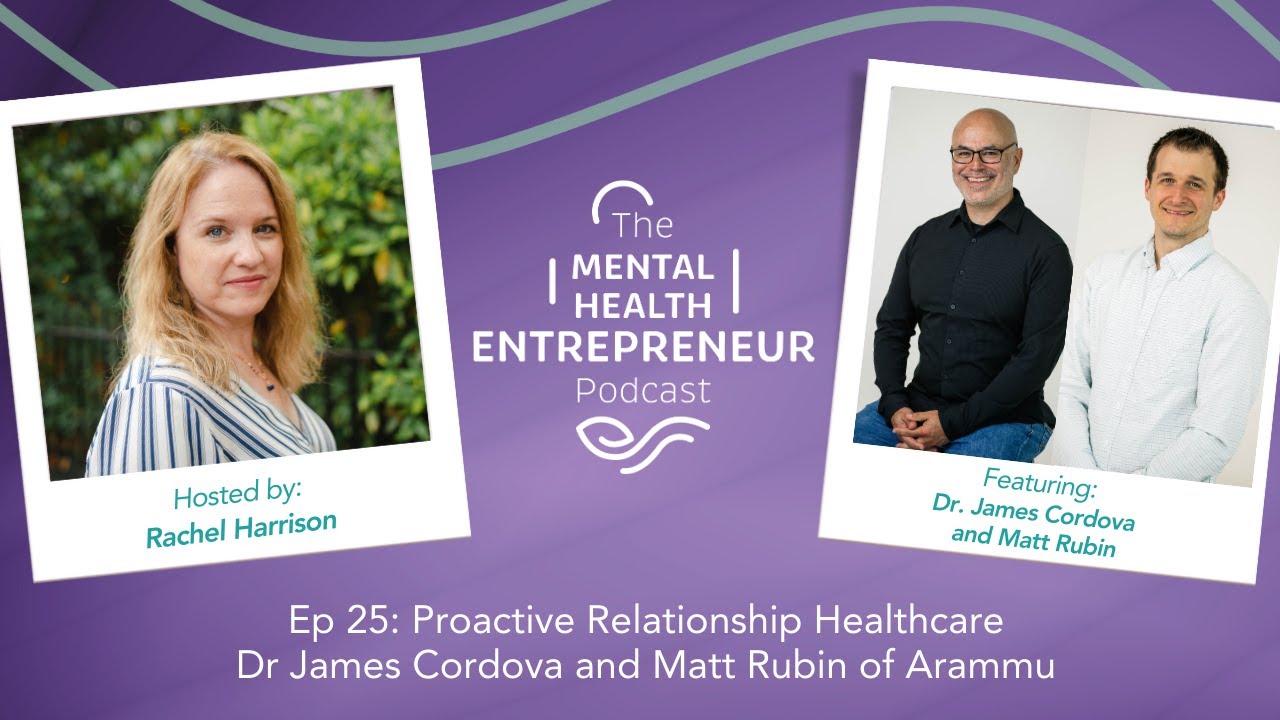
Proactive Relationship Healthcare | Dr James Cordova and Matt Rubin of Arammu
Shared theme: preventative care

Expanding EMDR Therapy To A Group Setting | Regina Morrow Robinson of The Book, EMDR Group Therapy
Shared theme: access to care
Making Self-Help Resources Accessible to All | Diana Partington of the Book, DBT for Life
Shared theme: access to care