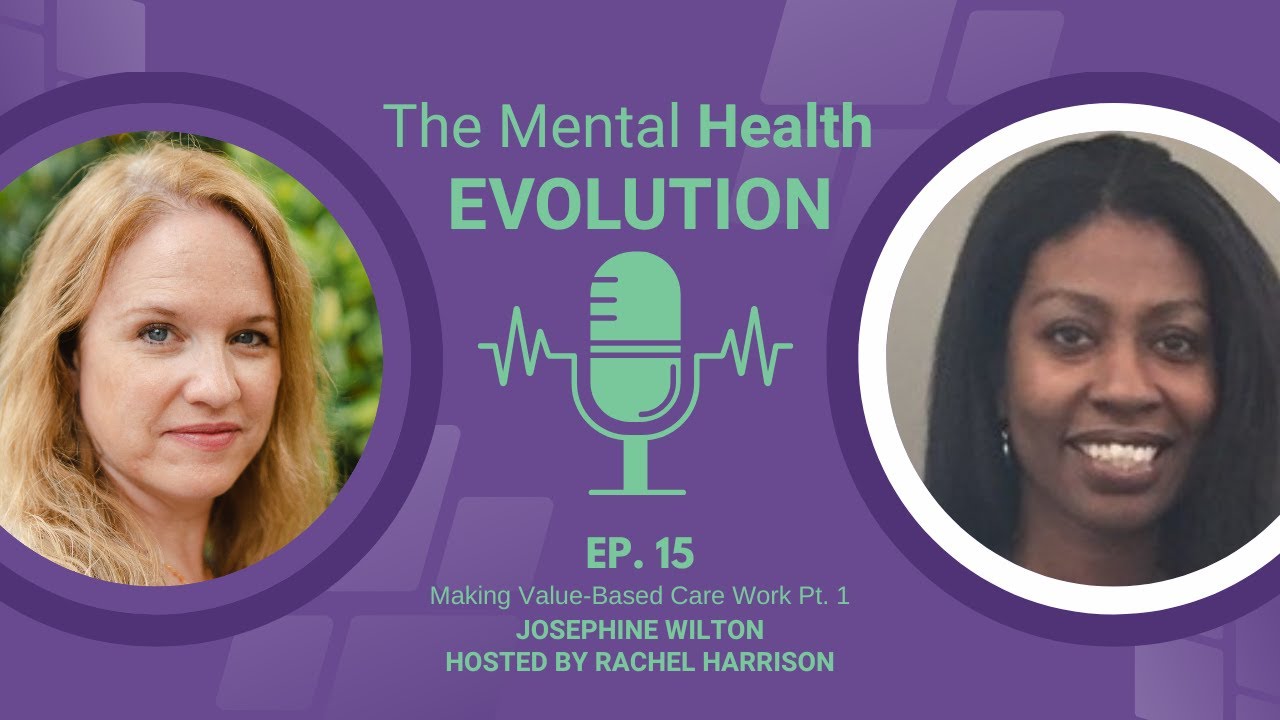
Why Value-Based Care Can Feel So Hard with Josephine Wilton, Pt. 2
Episode summary
Behavioral health providers cede ground in value-based care negotiations when they fail to understand their own utilization data and contracts well enough to make the case for themselves.
6 key takeaways
- Health plans build VBC metrics from aggregated claims data, which often does not account for geography, social context, or the specific patient population a behavioral health provider actually serves.
- Consistent revenue does not mean a contract is optimized; many behavioral health organizations are leaving money on the table by accepting terms they have never fully reviewed.
- Providers have more leverage in VBC negotiations than they typically use, but that leverage only materializes when they come to the table with their own utilization data to counter health plan benchmarks.
- Social determinants of health are fluid and change faster than annual screening cycles, but low reimbursement has created a data gap that makes it harder for providers to build the business case for more frequent SDOH support.
- Behavioral health is increasingly being included in value-based payment arrangements as payers recognize that primary care cannot address total cost of care alone.
- You do not need a contract attorney to begin understanding your insurance agreements; someone in your organization with strong reading comprehension can start the review and flag issues worth escalating.
Key moments
-
Josephine Wilton
"It's very incumbent upon you to tell your story in your way. Don't let someone else tell your story."
Condenses the episode's central argument into two sentences that any practice owner can act on immediately.
Watch this moment -
Josephine Wilton
"You look at your financials or revenue cycles, probably consistent. But that doesn't mean it's right. That doesn't mean you're optimizing the terms that you agreed to."
Disrupts the assumption that steady revenue means a healthy contract, a belief many small and mid-size behavioral health practices hold without questioning.
Watch this moment -
Josephine Wilton
"You hear about patient compliance, but why should I, why should I even know about this and care about your value based payment? I just have a need and I need the service."
Puts the patient perspective at the center of a conversation usually dominated by payer mechanics, a framing clinicians will immediately recognize from their own practice.
Watch this moment -
Rachel Harrison
"That's what I feel like I am learning from you in this conversation is understand your own data, your own value, your own numbers, and then be able to make the case for yourself."
Rachel's synthesis lands as a clear, repeatable takeaway, direct enough to work as a subject line, a social caption, or the closing line of a recap post.
Watch this moment -
Rachel Harrison
"And for organizations that are not tracking their utilization data, that then becomes a piece of information that's really important to pay attention to."
Rachel names a gap that many smaller behavioral health practices are quietly aware of but have not addressed, making it a natural prompt for self-assessment.
Watch this moment -
Josephine Wilton
"Urban setting does not mean you have excellent access to care. Access to care is not just based off of geography, but certainly that's a big part of it."
A short counterintuitive observation that challenges a common assumption, useful as an opener that earns a reader's attention before getting into VBC mechanics.
Watch this moment
Episode Description: In this second part of her conversation with Josephine Wilton, Chief Strategy Officer at Hullanta Consulting, Rachel dives deeper into the complexities of value-based care. Josephine draws on decades of experience in managed care strategy, population health, and contract design to explore why these models often feel difficult to implement.
This episode examines the operational realities behind value-based care, including the importance of utilization data, the impact of contracts on organizational performance, and the necessity of interdisciplinary collaboration. Listeners will gain actionable insights on how to navigate these challenges, advocate for their teams, and optimize care delivery in a system that is constantly evolving.
Key Topics Discussed:
-
Understanding the impact of value-based payment measures on provider organizations
-
Why utilization data is critical for telling your organization's story
-
Contract design and its influence on revenue, operations, and organizational outcomes
-
Engaging specialists and ancillary providers in value-based care
-
The role of social determinants of health in patient outcomes and reimbursement
-
Strategies for data-driven decision-making and negotiating with health plans
Main Takeaways:
-
Ownership of your data is essential — know your utilization metrics and communicate your story clearly
-
Value-based care cannot succeed with primary care alone; specialists and ancillary providers must be included
-
Contracts influence all parts of an organization, not just payment; thorough review is critical
-
Collaboration across disciplines and sharing actionable data drives better outcomes
-
Advocating for your organization requires persistence and strategic negotiation with health plans
Notable Quotes:
-
"So it's very incumbent upon you to tell your story in your way. Don't let someone else tell your story." — Josephine Wilton
-
"Primary care cannot do it alone. You need cardiology, endocrinology, podiatry, everyone involved, and they typically haven't so they're contributing to the total cost. They're seeing different needs of the patients than the other providers." — Josephine Wilton
Resources Mentioned:
Connect with the Guest: Josephine Wilton, MHA Chief Strategy Officer, Hullanta Consulting hullantaconsulting.com
Connect with The Mental Health Evolution:
-
Website: mentalhealthevolution.com
-
Instagram: @mentalhealthevolution
-
LinkedIn: Mental Health Evolution Podcast
-
Facebook: Mental Health Evolution Podcast
Music Credit: Music by Zach Harrison
Read the transcript
Automatically transcribed, so there may be small errors.
Read the transcript
Automatically transcribed, so there may be small errors.
-
0:05 Rachel Harrison
welcome to Mental Health Evolution, a podcast about what's changing in mental health and why it matters. I'm your host, Rachel Harrison, inviting you into honest conversations with people from all perspectives in the field. Clinicians, tech founders, investors, insurance companies, and all the folks in between. Let's explore what's working, what's not, and what's next.
-
0:30 Rachel Harrison
As we're introducing this episode, I wanted to hop on and say that this is a part two. So if you didn't catch Josephine Wilton last time, please make sure that you go back and listen to part one. You of course can listen to just part two if that's how you roll. But if you want a little bit more context in hearing more about the articles that we were talking about, go on back to the previous week's podcast and we will have that for you. So without further ado, you will jump in to part two of the conversation with Josephine Wilton about value based care and how to implement that. Best to switch this to and now I'm looking at maybe it's measures like the PHQ or something like that, maybe it's survey data from the patient, you know, things like that that are suddenly tied to that that is so brand new and additional layers of systems and work to collect that data.
-
1:32 Josephine Wilton
Correct. And when you mentioned patient surveys, that's a touchy one for providers typically, even in my experience working with skilled nursing facilities and home health care providers who are rated on a star based system with cms and at least in the state where I predominantly work, New York state, other than the states, there's a patient survey aspect. Right. So even for hospitals and there's a lot of debate around, well, should we be penalized for a few surveys where it was a patient perspective. But on the whole we perform based off of dissertation as an outlier say. So there's always these to your point, right. What is, what is the best metric and best measures? I really think I was listening, participated in a webinar where I was just listening just yesterday with three psychiatrists were on and it was very interesting. So behavior health was the focus on topic and one of the psychiatrists said, you know, we know my colleagues and I on this call and out in the field we know what schizophrenia looks like from a diagnosis and how we would approach it. But a patient suffering from schizophrenia, person suffering from it in whatever geography doesn't apply to another social setting or geography automatically. And so you're not just, you're not just treating the disease and the illness. It's everything that. Right. It's everything that encompasses that individual impacts their life. If they're in a rural setting versus in an urban setting, what does your access look like? Urban setting does not mean you have excellent access to care. Access to care is not just based off of geography, but certainly that's a big part of it. And then what's acceptable? Right. You know, given the practice area, is it acceptable to provide predominantly virtual care? And I'm just saying this hypothetically, I don't even know for someone with schizophrenia, depending on where they are in their illness versus in person. You know, a lot of times the health plans are setting these measures based off of a lot of data and it doesn't take a lot of these variables into account. Right. So they're massive. And some of these payers, as you're, I'm sure you're watching, are getting bigger and bigger. There's a lot of consolidation happening.
-
4:03 Rachel Harrison
Yes.
-
4:03 Josephine Wilton
And with that. Right. With that, they're amassing more and more data and that data is aggregated, sliced and diced. And that's how a lot of the metrics and measures are set. That's why it's so important for the providers to understand their data and push back and say, that's fine and dandy, but here's what's happening within our organization. Because you don't drive to service. Right. You don't get to dictate what your patients receive per se. They come to you with what they need.
-
4:33 Rachel Harrison
Yeah.
-
4:33 Josephine Wilton
So it's really space. Right. That's why we started. There was a time we transitioned not too long ago to referring to patients. We called it to consumer. Right. Now we can certainly, if you look at other industries, retail, Walmart doesn't tell me when I walk in, where I should go and what I should buy. But they strategically try to place things at the front of the stores.
-
4:54 Rachel Harrison
They do, we all know that.
-
4:58 Josephine Wilton
Yeah, exactly. And quite honestly, I don't know if there was any deliberate attempt, but that's what value based care has tried to do. Right. You hear about steering patients, educating the patients, but really we need to lean more into a consumer mindset. It's what they need. Right. So ultimately, if I walk into Walmart, I'm going to see things talk front and center that I may not need and I may not engage, but how quickly am I able to get to what I need? And that depends on how they structure and organize a store and how easy is it for me to get in and get out, you know, But I should be able to without over restrictive processes and workflows, work through the process of what do I need? And some things I didn't know I needed. Right. That happens in retail and it's, that's for the benefit of the retailer. Right. We end up spending more money than we need it. We're like, oh, I didn't know this was there. And it happens in health care. The patients don't know they're coming for the needs that they have and they shouldn't know the billing structure. They shouldn't really need to be concerned about total cost of care. But the way these measures and metrics are set up, it puts a lot of responsibility on one provider versus another. And I'll share my insights on that. And then it's completely contingent upon, which always blows my mind of the patient compliant. Right. You hear about patient compliance, but why should I, why should I even know about this and care about your value based payment? I just have a need and I need the service. So it's really about, I get it about you do want to provide the care that's needed. This is about outcomes and there's a way to do that. And I have it. It's, it's subtle and it has to be deliberate. And that's where understanding your utilization data is so important. So not to belabor it, but when the providers are engaging in those discussions, free contract execution for VVP Health plan says these are the metrics measures based off of national best practice benchmark standards for our network, et cetera. Wherever they're getting your data from, you can push back and say, like I said earlier, that's fine. Here's what our utilization looks like. And don't rely on their claims data. Right. They're just another organization like you are. And there may be a lot of services and supports your organization's providing that they wouldn't necessarily identify in the claims or their data analysts are not looking for. Right. I've worked with a lot of data analysts, very brilliant, very sharp actuaries, epidemiologists, data scientists, you name it. And they're looking at it from one perspective, but it's not going to be from your perspective as a provider. Just keep that in mind for your listeners and viewers. So it's very incumbent upon you to tell your story in your way. Don't let someone else tell your story.
-
8:02 Rachel Harrison
Wow, I love that. And for organizations that are not tracking their utilization data, that then becomes a piece of information that's really important. To pay attention to it is and
-
8:16 Josephine Wilton
I've worked with some. It can seem very daunting and overwhelming. And obviously I've had a passion for contracts. For decades I've been working with contracts and everything lies there. But quite often chicken attorneys. I've had two attorneys tell me it takes a special kind of person and they said it with a smile to enjoy reading contracts wins and they do.
-
8:35 Rachel Harrison
I think that's true.
-
8:36 Josephine Wilton
Josephine. Two separate occasions, unsolicited, random. And I said I think the universe is telling me something I didn't. And coming from attorneys. Right. But I'll give you a use case where you know, working with an organization pretty sizable multi location or sites of service across spanning multiple counties. And there were some operational issues, administrative issues with claims denials. And I said I'd like to look at your contract. Seemed very random for them. They said listen, everything's in there. Everything's in there. Not just the numerical parts of it either. It's all in there. Every word impacts your organization in some way. And when I did that I discovered some other problematic things without even verifying or confirming. There's just some things that just were wearing reimbursement, the jerry I shouldn't probably it's not fair to say jerry rigging but just the I call it hip hopscotch or gymnastics that the provider unfortunately agreed to and determined reimbursement for any given visit. And it was a combination of the plan, the product, patient's age, gender, service, it was everything, you name it. So it was like if this, then that, then this, then that and then you get this little chump change. So there were a lot of things going on and I started to work with leadership to explain how the contract on the whole impacted the entire organization and folks throughout that hadn't ever reviewed it. You know, they were just used to looking at the output. Right. What are we getting paid? And so over time and I would say their revenue is pretty consistent. I would say for your listeners and viewers out there who are provider organizations, you look at your financials or revenue cycles, probably consistent. But that doesn't mean it's right. That doesn't mean you're. You're optimizing the terms that you agreed to. Yeah, right. And until you've fully optimized it, then you're kind of your starting point is not really ideal to layer on a VVP doesn't mean you don't do it. But you first want to understand your baseline.
-
10:58 Rachel Harrison
I love that perspective and I think how many providers have not really looked too deeply at their contracts. I mean, I think that's a pretty common experience.
-
11:09 Josephine Wilton
It is. Find someone in your organization doesn't have to be a lawyer. So someone who enjoys reading, who has good reading comprehension skill set and ask them to read it. When I trained contracting specialists that reported to me when I did this work in a leadership role on health plan side, first week, there was no test, but I would say read this contract. And it was like the biggest contract we had with all the administrators. Yeah, right. That was my style. Because if you're uncomfortable, you're not even intrigued or want to read a contract and I'm not so sure I can trust you to negotiate one. Right. And it's very easy for things to get in, certainly very difficult to get out, but it's very, very important. And you don't need to have an attorney on staff. I mean, ideally, if you can, but you're going to run up a big tab to have them review it. And attorneys are familiar and adept with provider contracts, you know, or they may be in that space, but they work for a health plan. And so it may be somewhat of a conflict. So just, just start with someone who has the basic sales skill set and is not averse to it in your organization. There's someone. There's absolutely someone. And that doesn't, it does not excuse your leadership, your CEO, et cetera, from doing it because contracts and amendments are being signed. Right. Continuously. And so that's why it's very imperative that there's review and scrutiny. But it can be done. It can be done. It's just acknowledging that it needs to happen. I'll add this note at a conference and I was very impressed with the CEO of the federally qualified health center, had got fairly new to the organization, but noted that in his time there, and certainly, I'm sure over a culmination of his experience, he realized data is so important to their success as an organization and to be able to innovate and move forward that they move to hiring. That's impressive. And I've worked with actuaries. A lot of providers and folks in the industry don't understand the difference between an actuary, a data analyst, an accountant, a CEO. You need everyone. Yeah, you need everyone. And so I was just so impressed by that. And I think it speaks to where the industry is going in terms of understanding more about where the deficiencies are. And I was pleased to hear that that CEO and I'm hearing from other leaders that they're understanding I need to start looking at my data and I need to start looking at my contracts and taking ownership in that regard and not just need accepting of where things are.
-
13:55 Rachel Harrison
You have given so much to think about with these implementation steps, even just sort of preparing people for awareness of their own organizations and kind of taking into account where we are right now before even thinking about next steps. Looking ahead, what else do you think might come into play or might be helpful in the industry? What trends are you seeing? What innovations, policy or data or partnership models do you think are going to start happening that will be related to value based care models?
-
14:29 Josephine Wilton
Well, one of the things that Rachel, might be right up your alley is that I noticed early on and I was the one raising my hand and asking questions when I was on the health plan side, why aren't we including more of our specialists and ancillary providers into these VVTs or just baffled me. Right? When you look at total cost of care, for example, highest cost, right. Hospitals, that's why everybody talks about let's bring down hospital costs for avoidable. Certainly there's a time and place that if it's avoidable and not medically necessary, we don't want the patient going there. The reasons why those patients have heard it from hospitals, seen it in the data and the providers that are servicing them. A lot of times, depending on geography, there are social circumstances. This is where social determinants of health come into play. You have people trying to shelter from the cold, from the elements, going to the hospital. They don't have utilities, certainly human health, mental health issues. And it's not linear, it's not one or the other, and it's fluid. You know, today I'm showing up in the ED because of this. Tomorrow it's these set of things. And unfortunately the way even now through 1115 waiver, right. There's a Social Security act that is available throughout the country and each state is kind of modeling it, how they choose to address social determinants of health. The payment for social determinants of health screening is tied to essentially one screening a year. Well, my situation is changing daily, minute by minute. So how do we address that? How do we ensure now certainly care coordination that there's a little bit more frequency in payment, but it's very low. Social determinants of health screening payment is low, at least when you look at in the aggregate and when I looked at New York State, so then that's where the provider has to use the data to try to make the argument of what they're doing, that they're not getting paid for and how it ties to total cost of care. See, that's where you have to make the business case for the health plan. Because it's not so much that they're trying to be tricky and they don't want to do it. They. They cannot. If it's not on a claim, they can't get to it. And historically, providers of all scopes of practice didn't bill for social determinants of health because there was no payment for it. So it's a resource issue. I don't get paid for. I'm not going to burden my administrative team to code and bill for it. Not good practice because now the data can't get over to the health plan. And I tested this out personally when I was on that side. But I understand why it happens. So what I see that can help is, like I said, bringing in your ancillary providers and specialists who were historically ignored. So behavioral health, everybody agrees behavioral health utilization needs to go up. The need is there. We need to. Certainly there's a shortage, but we need to support behavioral health organizations and organizations that provide behavioral health services. They need to find mental support. So reimbursement on the fee for service level needs to be increased and providers can negotiate. It's a free market. It's America. They can say no. I'm used to no. They will tell you no. And you just keep pushing past the no until you get to yes. Right. I think there's even a book titled that Getting to Yes. I haven't read it, but yeah, it was recommended some time ago. I'm not exclusive to reading it, but yeah, I think it's called getting yes or getting past no. I think there's two volumes. So don't. I would say your providers don't be afraid to hear no again. Look to the person on your team for the CEOs. Maybe it's not your strength, maybe it's not something you've practiced yet, but you've got a pretty well informed and eager CMO who's willing to do it. It doesn't matter. There's no rule that says it has to be this person or that person. Just make sure it's data driven and they understand some of the fundamentals of it and just go for it. It's not going to happen on its own. So behavioral health, I'm hearing more and more about services like that being put on direct value based payment arrangements, which is awesome. So we'll give you more money, but we're going to incentivize it. We recognize you need more in terms of revenue. Well, it could be a combination of fee for service and a VVP methodology. That could be risk based or non risk based. Purely incentive. There may be upfront funds. A lot of times you'll see a per member per month payment that's strictly volume based. Where I talked about attribution. How many patients are attributed to this VBP on a monthly basis? They'll give you $10, $5, $2, whatever it is to cover your administrative costs. These are all negotiation points. And they're seeing more and more where health plans are offering it to national area specialist providers. Again, primary care cannot do it alone. You need cardiology, endocrinology, podiatry, everyone involved. And they typically haven't been. So they're just, they're contributing to the total costs. Right. And they're seeing different needs of the patients than the other providers. Right. So everyone needs to talk. There needs to be data sharing, more data sharing. And in a way that's actionable, depending on your provider types and scopes of practice or specialties is very, very key. So dental oral care has been left out. I'll be honest, I don't see as much happening in VBP space around that. But I hope we get there. I truly do. The data is there. It's incumbent upon those oral care providers and institutions or organizations that provide oral care along with other disciplines of care. They have to make the case. They have to make the case and they're only going to be able to make the case through the data.
-
20:30 Rachel Harrison
That's what I feel like I am learning from you in this conversation is understand your own data, your own value, your own numbers, and then be able to make the case for yourself. So we are pretty much out of time. Josephine, you are a wealth of knowledge and I feel like you could keep talking. We've already made kind of a part one and part two episode, which I love because I think this is so crucial and there are so many things that people do not understand about value based care systems. So thank you for everything that you have shared. We will definitely include Josephine's information if you want to reach out and contact her, get more data, get more information. She's clearly an expert in this field. So thank you so, so much for being here. I have enjoyed every moment of chatting with you today.
-
21:26 Josephine Wilton
Thank you, Rachel. This has been a pleasure. And thank you to everyone who's listening and watching and who knew. I really appreciate it. This has been a great discussion.